
The 24-Hour Organ Clock
In Medical Qìgōng and Chinese Medicine
~ Resource Center ~
What Is the 24-Hour Organ Clock in Traditional Chinese Medicine and Medical Qìgōng?
The 24-Hour Organ Clock, sometimes called the Chinese medicine body clock, illustrates how Qì moves through the body’s organ systems across the day and night. In Traditional Chinese Medicine and Medical Qìgōng, this rhythm helps practitioners observe patterns of energy, rest, and restoration within the body.
Click image ⤵ to enlarge
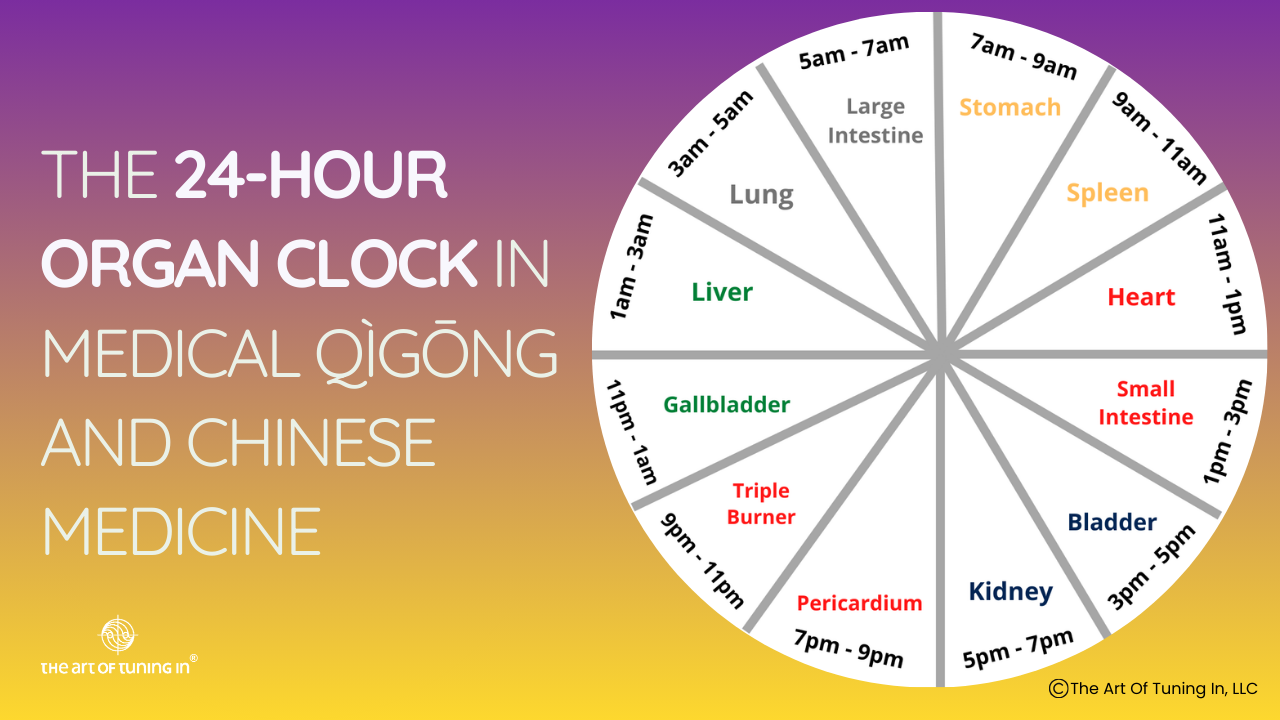
The 24-Hour Organ Clock in Medical Qìgōng and Chinese Medicine
The 24-Hour Organ Clock, sometimes called the Chinese medicine body clock, describes how Qì flows through the body’s organ systems across a full day and night in both Traditional Chinese Medicine and Medical Qìgōng. Practitioners observe these natural rhythms to better understand patterns of energetic stagnation, excess, deficiency, and balance within the body.
In clinical observation within Traditional Chinese Medicine and Medical Qìgōng, practitioners often note when symptoms consistently appear at the same time of day, because repeating patterns can offer insight into how Qì is moving—or where it may be constrained—within the organ systems.
Each organ system has a two-hour period when its Qì is most active. Recognizing these cycles can provide insight into sleep patterns, energy levels, digestion, and emotional rhythms, as well as the timing of certain symptoms that arise throughout the day.
In Medical Qìgōng, the organ clock can also help guide when certain practices may best support energy discharging (releasing), balancing, or tonification (restoration)—helping restore the smooth movement of Qì and supporting overall energetic harmony.
What About Daylight Saving Time and the Organ Clock?
One question that comes up every year is about daylight saving time. If the clock on the wall suddenly shifts forward or backward by an hour, what does that mean for the body’s own timing? And how do we know what the real time of our body is living in?
Modern circadian rhythm research offers an interesting perspective. The body’s internal rhythms are not primarily governed by the clock on the wall. They are shaped by light exposure, sleep patterns, daily habits, and consistent routines, which together regulate our internal biological timing.
When daylight saving time changes, the clock shifts immediately, but the body often takes days or even weeks to fully adjust. During this period the body may experience a temporary mismatch between external time and internal rhythm.
From the perspective of Traditional Chinese Medicine and Medical Qìgōng, the organ clock reflects the body’s internal rhythm of Qì circulation. This means it can be helpful to observe when your body naturally wakes, rests, or experiences symptoms, rather than relying only on the changed clock time.
For example, if someone consistently wakes around 1:30 a.m., the organ clock may still offer insight into what the body is processing energetically—even when daylight saving time has shifted the numbers on the clock.
Over time, as sleep patterns and light exposure stabilize, the body gradually synchronizes with the new seasonal rhythm.
The body listens to light, rhythm, and habit more than it listens to the clock on the wall.
Interestingly, modern chronobiology has also discovered that many organs in the body have their own biological timing cycles, sometimes referred to as peripheral clocks. The liver, lungs, digestive system, and other organs follow predictable daily metabolic rhythms that influence digestion, hormone production, immune function, and cellular repair.
While the language is different, this modern understanding echoes what practitioners of Traditional Chinese Medicine and Medical Qìgōng have observed for centuries—that the organs express different functional strengths at different times of the day.
Listening to the Body’s Natural Rhythms
Understanding the 24-Hour Organ Clock invites us to begin listening more closely to the body’s natural rhythms. When we observe how our energy rises, settles, and restores throughout the day, we begin to cultivate a deeper relationship with our own Qì.
Inside The Art Of Tuning In Studio, we explore these rhythms through guided Medical Qìgōng practice, seasonal cultivation, and practical tools for strengthening and balancing your energy in everyday life.
If you feel called to deepen this relationship with your body’s natural cycles, you’re warmly invited to explore the Studio.
↓
Choose Your Path
Whether you're looking for personalized coaching, an immersive program, or an ongoing community of practice, there's a path designed to support where you are and where you'd like to grow.
↓

Immersive Group Programs
Multi-week guided experiences designed to strengthen your energy, deepen your intuition, and create lasting transformation.
Frequency Tuning™ (1:1)
Private coaching for mastering the art of tuning your frequency through personalized guidance and intentional practice.
The Art Of Tuning In® Studio
Two membership pathways for ongoing practice, community, and energetic support: Seasonal Practice (open to all) and the Women's Studio.
Not sure which path is right for you?
I'm always happy to answer questions and help you decide where to begin.
Shall we stay in touch?
As a welcome, you'll receive my 4-minute Root the Mind practice.